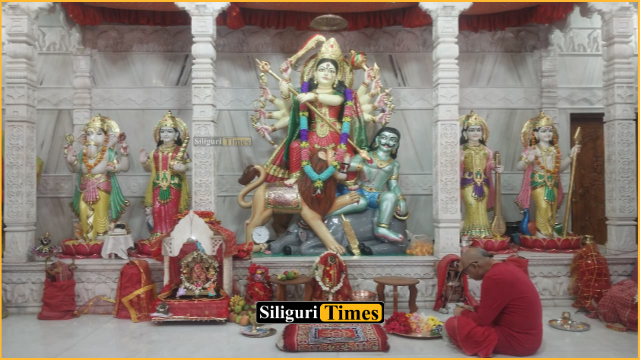
Siliguri, 16th October: Anandamoyee Kalibari, one of the oldest temples in Siliguri, is preparing to celebrate its 96th Durga Puja, bringing together history, heritage, spirituality and social service. The upcoming celebrations have generated enthusiasm among devotees, with the temple committee placing special emphasis on preserving its rich legacy alongside religious rituals, cultural traditions and community welfare initiatives.
The history of Anandamoyee Kalibari is closely associated with India’s freedom struggle and the contributions of renowned Bengali folk poet Mukunda Das. According to local accounts, Mukunda Das arrived in Siliguri in 1924 while evading British police and took shelter in the town. Distressed by the poor condition of a small, dilapidated temple established through the initiative of local traders, he reportedly took steps to improve it by donating funds raised through Swadeshi songs, theatrical performances and cultural programmes, while encouraging local residents to contribute.
In 1926, a Kali idol carved from black stone was installed at the temple, which was subsequently named Anandamoyee Kalibari. Durga Puja celebrations began on the temple premises in 1932. Despite British police surveillance during the colonial period, local accounts suggest that revolutionaries held secret meetings and carried out activities associated with the freedom movement under the cover of religious gatherings. This history has made Anandamoyee Kalibari a place of religious significance as well as a site associated with India’s struggle for independence.
One of the major attractions of Durga Puja at Anandamoyee Kalibari is the distribution of bhog prasad among devotees. The puja holds considerable importance for people across Siliguri and the surrounding rural areas. Residents of at least 60 villages, including Naxalbari, Kharibari, Phansidewa, Ghoshpukur, Hanskhawa, Ramdhanjote and Rabindranagar, visit the temple to receive the goddess’s prasad.
During the puja days, devotees begin gathering at the temple premises from as early as 4 am. Long queues form as people travel from distant areas to receive the bhog, which includes rice ‘khichuri’ and other offerings. This longstanding tradition continues to draw large numbers of devotees every year, fostering a sense of unity and communal harmony among people from different communities and localities.
Alongside its religious and cultural activities, the Anandamoyee Kalibari committee has also undertaken social welfare initiatives. As part of its efforts to support underprivileged tea garden workers and children, the committee has launched a clothing distribution programme. Clothes have already been distributed among workers and children at two tea gardens, and the committee plans to extend the initiative to several more tea gardens in the coming days as part of its centenary-related activities.
At a time when Durga Puja celebrations are increasingly marked by elaborate themes and grand decorations, Anandamoyee Kalibari continues to prioritise its longstanding traditions, historical significance and social responsibilities. Its 96th Durga Puja thus represents more than a religious celebration, bringing together memories of the freedom struggle, Bengali culture, a rich historical legacy and a continuing commitment to serving society.